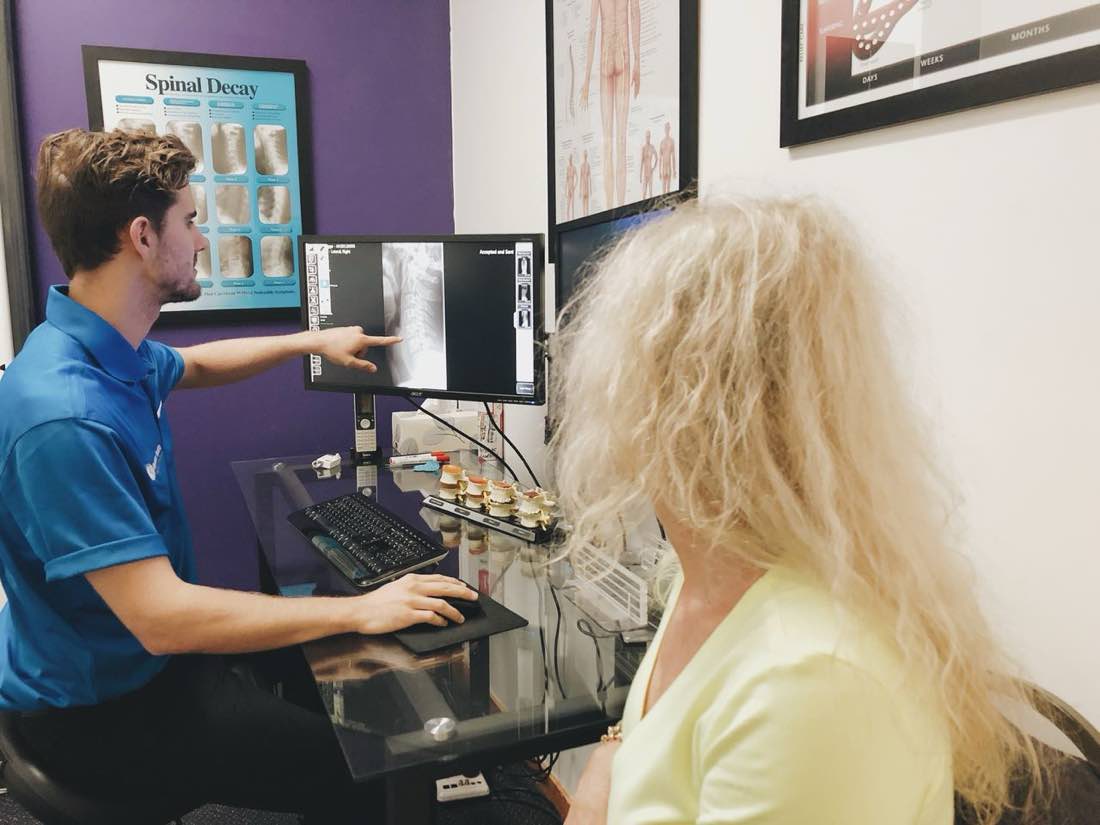
Scoliosis affects more people than most realise. Whether it was picked up in adolescence or noticed in adulthood, getting a proper assessment is the critical first step. We use on-site digital X-ray and MotionIQ analysis to measure and understand your curve, then build a management plan around what we actually find.
Written and clinically reviewed by Matthew Smith (Chiropractor) and Geoff Villacis (Physiotherapist) · Reviewed August 2026
Scoliosis is an abnormal lateral (sideways) curvature of the spine, typically accompanied by rotation of the vertebrae, that measures greater than 10 degrees on an X-ray using the Cobb angle method. It's not just a postural quirk - significant curves can cause pain, restrict movement and, in severe cases, affect lung and heart function.
The most common type is adolescent idiopathic scoliosis (AIS), which develops during the growth spurt between roughly 10 and 16 years of age and has no single identifiable cause. Degenerative scoliosis develops in adulthood from asymmetric disc and joint wear. Congenital scoliosis involves vertebral abnormalities present from birth.
What matters clinically is the Cobb angle (degree of curve), the curve pattern, whether the spine is still growing, and what symptoms are present. Curves under 20 degrees are usually monitored. Curves of 20-45 degrees typically need active management. Curves over 45-50 degrees may require orthopaedic consultation for surgical assessment - and we'll be direct about that if we reach that point after assessment.
The Cobb angle is the standard measurement for scoliosis severity, measured on a standing X-ray between the most tilted vertebrae above and below the curve apex. This is a key reason why on-site digital X-ray is central to scoliosis assessment.
Scoliosis management typically starts with chiropractic assessment (for X-ray measurement and structural analysis) and incorporates physiotherapy for exercise rehabilitation. Here's how each discipline contributes.
Chiropractic is central to scoliosis assessment and conservative management. The core diagnostic tools are on-site digital X-ray - to measure the Cobb angle and classify the curve pattern - and MotionIQ motion analysis, which shows how the scoliosis affects spinal movement and function in a way that a static X-ray alone cannot reveal.
For mild-to-moderate curves, chiropractic care aims to reduce associated joint dysfunction and pain, improve segmental movement, and support posture. Progress is monitored with serial X-rays as appropriate. For growing adolescents with curves in the 25-45 degree range, bracing may be recommended in conjunction with care. Curves over 45-50 degrees will be referred for orthopaedic consultation.
Physiotherapy for scoliosis focuses on the muscles, breathing and movement patterns around the curve. The Schroth Method is the most well-supported physiotherapy approach for adolescent idiopathic scoliosis - a series of three-dimensional exercises designed to elongate, derotate and stabilise the scoliotic curve within functional movement.
For degenerative scoliosis in adults, where pain management and function are the primary goals, physiotherapy provides manual therapy, targeted strengthening and movement optimisation.
Where should you start? For scoliosis, we recommend starting with a chiropractic assessment - digital X-ray gives us the Cobb angle measurement and curve classification that underpins all management decisions. Physiotherapy is then introduced for rehabilitation and exercise components. We coordinate both under one roof.
Your first consultation starts with a thorough assessment - we don't assume we know the cause before we've examined you. Our chiropractors routinely use MotionIQ to measure exactly how your spine is moving, and re-measure later to check the movement is genuinely coming back. If you are booking with a physiotherapist and want a MotionIQ assessment included, please ask when you book. Here is why that matters.
Dealing with scoliosis on the Sunshine Coast?
Our chiropractors and physiotherapists treat this every day in Mooloolaba and Nambour — same-day appointments are often available.
Yes - chiropractic is particularly well-placed for scoliosis assessment and conservative management. On-site digital X-ray lets us measure the Cobb angle accurately and track change over time. MotionIQ motion analysis reveals how the curve affects dynamic spinal function. Chiropractic treatment for scoliosis focuses on reducing associated joint dysfunction and pain, improving segmental movement, and supporting posture. It does not straighten structural curves, but it significantly helps with the symptomatic and functional impact.
Yes. The Schroth Method - a physiotherapy approach specifically developed for scoliosis - uses three-dimensional exercises to elongate, derotate and stabilise the curve within functional movement. It has good evidence support for adolescent idiopathic scoliosis and is used in conjunction with bracing and monitoring for growing adolescents with moderate curves. For adults with degenerative scoliosis, physiotherapy focuses on pain management, strength and movement optimisation.
Surgical intervention (typically spinal fusion) is generally considered for curves over 45-50 degrees in skeletally mature individuals, or for rapidly progressing curves in growing adolescents. Curves between 20-45 degrees are typically managed conservatively with exercises, bracing (for adolescents) and monitoring. Below 20 degrees, observation and exercises are standard. These thresholds are guides - the full picture includes the patient's age, skeletal maturity, symptoms and quality of life.
The structural curve itself cannot be fully corrected without surgery in most cases. However, conservative management - chiropractic care, Schroth exercises and bracing for adolescents - can stabilise a curve, prevent progression, and significantly reduce the pain and functional impact. Many people with mild-to-moderate scoliosis live very well with appropriate conservative management throughout their lives.
A chiropractic assessment is a sensible first step. Digital X-ray allows accurate Cobb angle measurement - which is the foundation for all management decisions - and MotionIQ shows how the curve is affecting their movement. From there, we can advise on whether monitoring, active management, Schroth exercises, bracing consultation or orthopaedic referral is the right path. We work with adolescent scoliosis regularly and approach it with appropriate care.
No referral is needed to book directly with us. However, a GP referral (Chronic Disease Management plan) is needed to access Medicare-subsidised allied health visits. You can also contact us directly to book a scoliosis assessment and we can advise on next steps from there. Book online or call (07) 5478 2333.
Same-day appointments at Mooloolaba (on-site digital X-ray) and Nambour. The earlier you understand your curve, the more management options are available.
We'll get back to you shortly · or call (07) 5478 2333