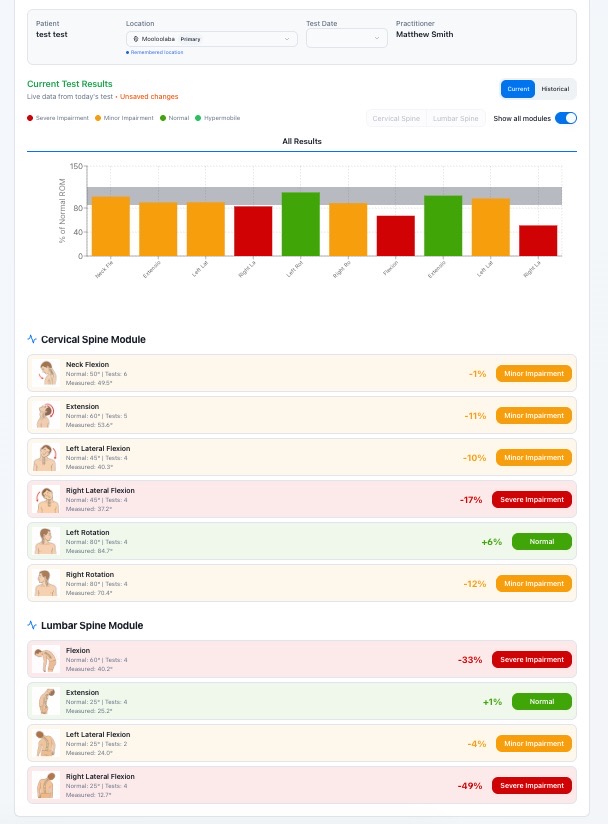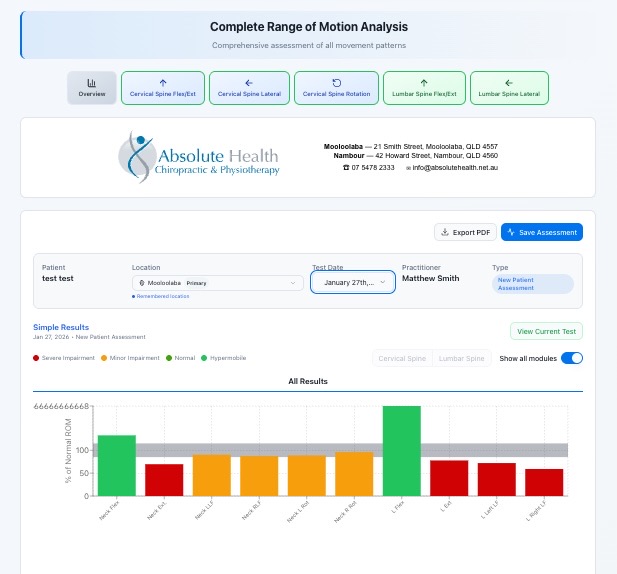
MotionIQ uses clinical-grade wireless sensors to measure how your spine moves - to a fraction of a degree - mapping problem areas that were once almost impossible to assess by hand.
Spinal restriction is notoriously difficult to assess by eye or by hand. Two people can have very similar pain but completely different underlying problems - and small but important losses of movement are easy to miss.
MotionIQ removes the guesswork. By capturing exactly how far, how freely and how symmetrically each part of your spine moves, we can locate the precise segment and direction that is restricted, identify asymmetries between left and right, and build a clear, measurable picture of what is actually driving your symptoms.
It's the kind of precision once reserved for elite sports science and research labs - now applied directly to assessing your spine, as a standard part of how we assess spinal problems. If you want the detail, we've written about why restoring joint motion matters and what the research shows.
Cartilage, the smooth load-bearing surface inside a joint, has no blood supply of its own. It relies on movement to push joint fluid in and out, and that exchange is how it is fed and how waste is cleared. Reduce the movement and you slow the exchange.
A 2023 study in Arthritis Research & Therapy found that long-term joint immobilisation produced osteoarthritis-like lesions in both animal models and human patients, including cartilage loss, joint inflammation and bone spur formation. Some of those changes improved once normal motion and loading were restored.
A widely cited review in the Annals of the New York Academy of Sciences reached the same conclusion from another direction: moderate loading maintains the integrity of articular cartilage, while both disuse and overuse degrade it.
The whole scan takes about a minute and fits inside a normal appointment. All of our chiropractors use it routinely. If you are booking with a physiotherapist and you want a MotionIQ assessment included, please ask when you book.
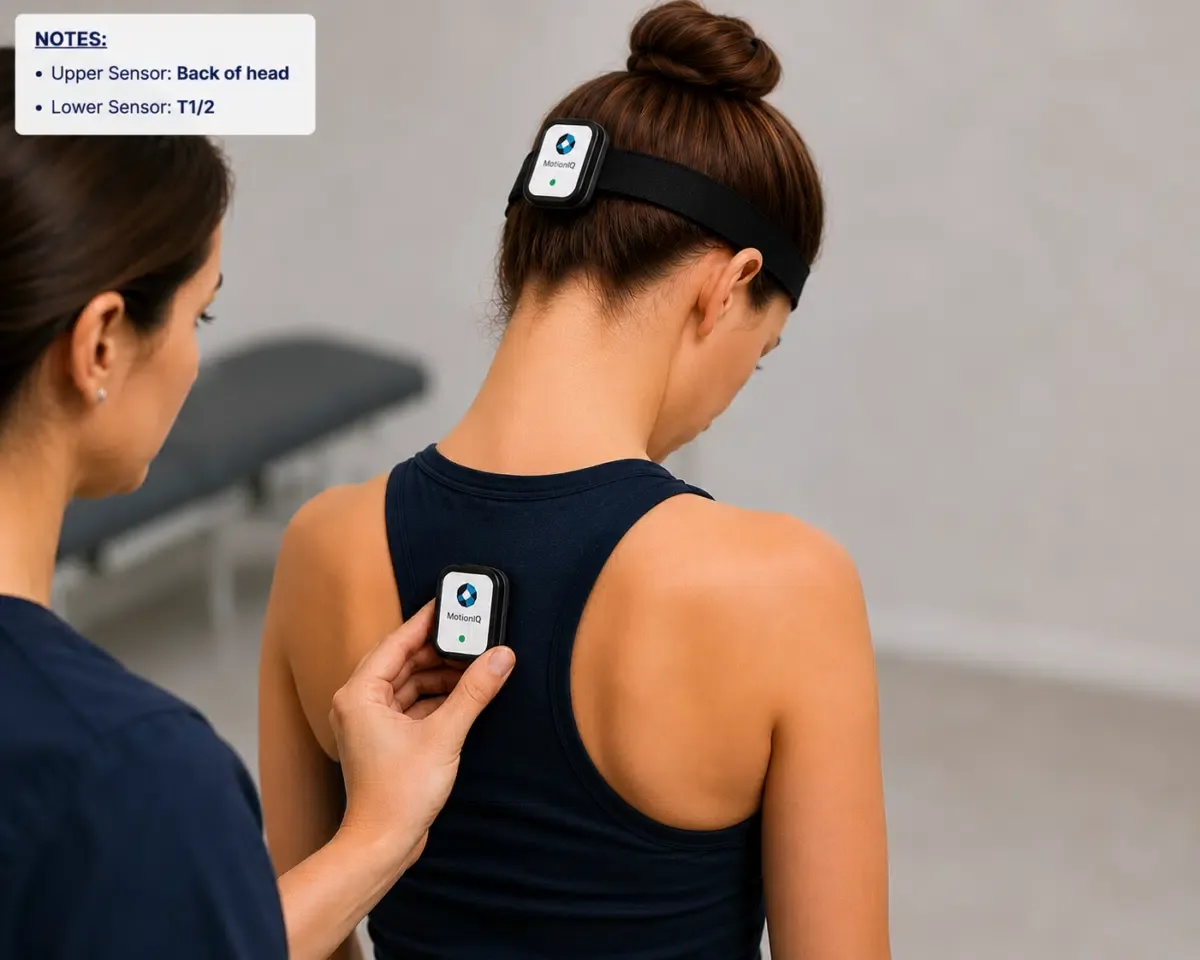
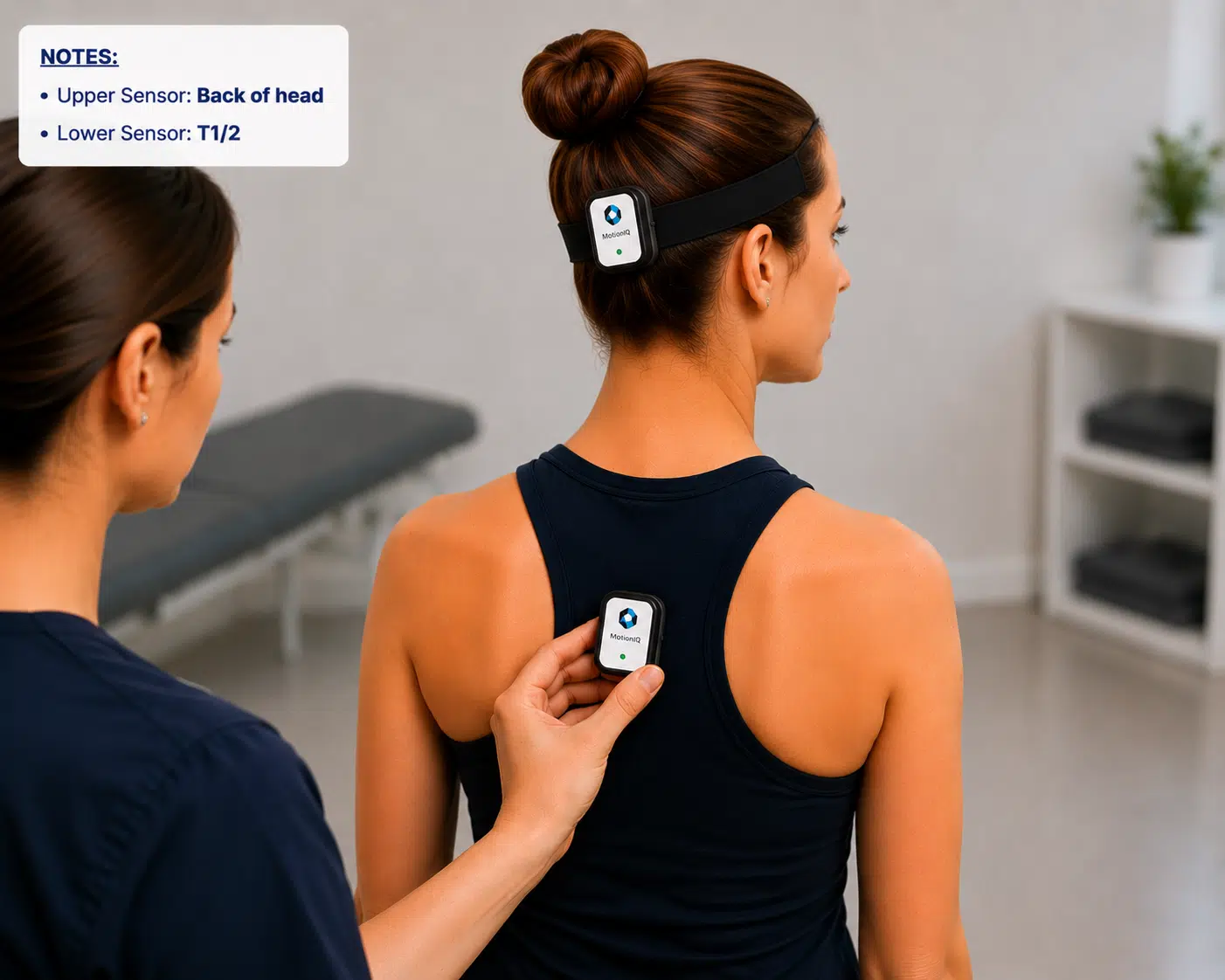
Small wireless sensors are gently strapped to your neck or lower back - no wires, no discomfort.
You move through a few simple ranges of motion while the sensors record every degree in real time, at 60 frames per second.
Your movement is compared against normal ranges, flagging exactly which segments and directions are restricted.
We review the findings with you, explain what they mean, and use them to target and track your treatment.
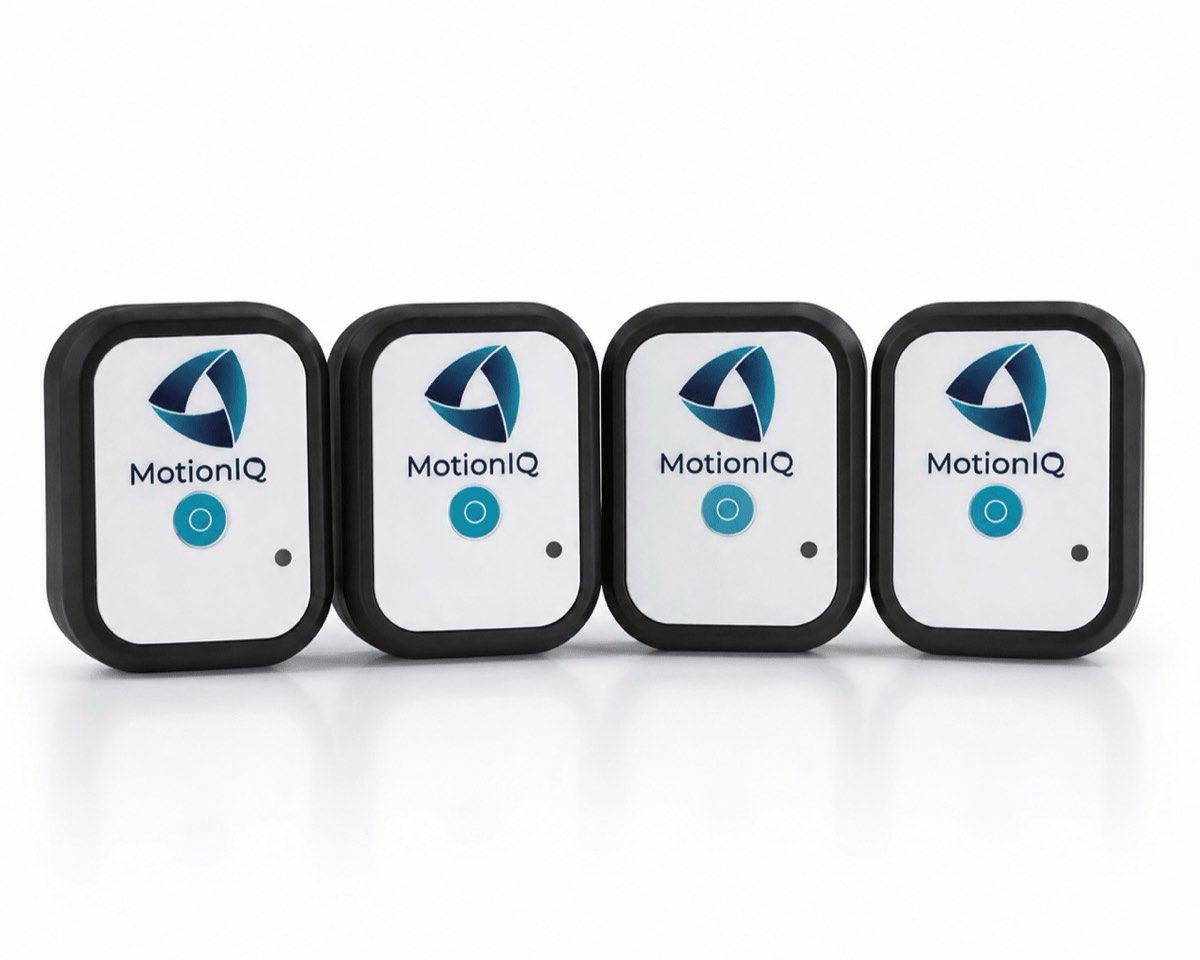
MotionIQ uses lightweight, medical-grade wireless sensors that read spinal movement with high precision and reliability - no cables, no bulky equipment, no discomfort.
Every assessment is saved to your record, so each new scan can be measured against your first one and you can see exactly how your movement is changing across your plan of care.
Example results. Individual findings vary.
The scan at your first visit sets your baseline. The more useful number is the second one.
Partway through your care we run the same assessment again and compare it against that baseline. It answers a question “how does it feel?” never can: is the movement genuinely returning? If it is, we have evidence the plan is working. If a segment has not shifted, we know to change approach rather than repeat the same thing for another six weeks.
That matters because restoring healthy motion is the thing the research links to protecting your joints from long-term degenerative change. It also gives you something concrete to look at, rather than a memory of how last month felt.
MotionIQ helps us assess, diagnose and monitor a wide range of spinal conditions - including many where the underlying restriction is difficult to detect by eye.
Cervicogenic headaches driven by restricted or asymmetrical neck movement.
Disc bulges and herniations in the neck that limit how freely it moves.
Lower-back disc injuries that restrict bending, extension and rotation.
Movement restrictions linked to nerve-related leg or arm symptoms.
Abnormal spinal curvature and the movement asymmetry it creates.
Spondylosis and age-related wear that progressively stiffens the spine.
Forward slip of a vertebra affecting lower-back stability and motion.
Loss of motion following trauma, measured and tracked through recovery.
Long-standing neck and back pain where restriction is hard to see by eye.
MotionIQ is a motion-capture assessment system that uses small wireless sensors to measure exactly how your spine moves, with sub-degree accuracy. It gives us objective data to pinpoint and track spinal problems that are hard to measure by hand.
No. Small wireless sensors are gently strapped to the skin over your spine. There are no needles, no radiation and no discomfort, and the whole scan takes under a minute.
It is used for headaches and migraines, cervical and lumbar disc disorders, sciatica, scoliosis, degenerative spine conditions, spondylolisthesis, whiplash and chronic neck or back pain, among others.
X-rays and MRIs show the structure of your spine at rest. MotionIQ measures how your spine actually moves, revealing functional restrictions that static images can miss. It complements, rather than replaces, medical imaging.
A stiff joint is not a diagnosis of arthritis, and most restricted joints never become arthritic. What the research supports is narrower: joints held out of normal motion for long periods develop osteoarthritis-like changes, and restoring motion partly reverses some of them. It is a good reason to find and treat lost range early.
Generally after a block of care rather than at every visit, so there is enough time in between for a real change to show against your baseline. We review the comparison with you when we do.
Yes, but it is not part of a standard physio appointment. All of our chiropractors use MotionIQ routinely. Our physiotherapists do not, so if you want a scan included with a physio appointment, please mention it when you book.
No referral is needed. You can book directly with Absolute Health. If you are seeing a chiropractor the assessment is included as a matter of course; with a physiotherapist, please ask for it when you book.
Same-day appointments are often available at our Mooloolaba and Nambour clinics. Book online in under a minute, or give us a call.
We'll get back to you shortly · or call (07) 5478 2333