Joints are built to move, and movement is a big part of what keeps them healthy. When a joint quietly loses range, the tissue inside it starts to change. By the time stiffness or pain turns up, that change is often already underway. It is the reason we measure how your joints move instead of estimating it by eye.
What lost motion does to the tissue
Almost nobody feels a joint losing range. There is rarely a moment you can point to. It happens across months or years, through an old injury that never fully settled, a desk setup, a repetitive job, or a joint you have been quietly guarding since something hurt.
Cartilage is why this matters. The smooth, load-bearing surface inside your joints has no blood supply of its own. It relies on movement and loading to push joint fluid in and out, and that exchange is how cartilage gets fed and how waste gets cleared. Reduce the movement and you slow the exchange.

What the research shows about joints that stop moving
A 2023 study in Arthritis Research & Therapy examined what long-term immobilisation actually does to a joint. In patients immobilised for six weeks, the researchers recorded joint pain and osteophytes, the bony spurs associated with arthritic change. In mice immobilised for four and eight weeks, they found inflammation and increased nerve growth in the synovium, substantial spur formation along the femoral condyles and the edge of the tibial plateau, and significant loss of articular cartilage. The lesions looked like osteoarthritis.
The encouraging half came next. Once normal load and activity were restored, some of that damage and some of the lost joint function came back.
A widely cited review in the Annals of the New York Academy of Sciences arrived at the same place from a different direction. Moderate mechanical loading maintains the integrity of articular cartilage. Both disuse and overuse degrade it, and irreversible cartilage destruction is the hallmark of osteoarthritis.
Work published in The FASEB Journal filled in part of the mechanism. Immobilising rat hind limbs raised MMP-1, an enzyme that dismantles the cartilage matrix, and cartilage degraded rapidly. One hour a day of passive joint motion prevented it. In human cartilage cells, moderate pressure suppressed the same enzyme while high pressure increased it. Too little movement and too much load both cause trouble. The middle is where cartilage does well.
Joints that lose normal motion are at genuine risk of degenerative change, and restoring healthy movement is a real part of protecting them.
Two honest caveats. Much of this work is done in animals, and the immobilisation involved is far more complete than anything that happens to a stiff neck. A restricted joint does not mean you are headed for arthritis. But the evidence points consistently enough in one direction that we would rather find lost motion early and do something about it.
Why we measure instead of guessing
Range of motion has traditionally been judged by watching someone bend and turn, sometimes with a goniometer. That is quick, and it is adequate for large, obvious losses. It is poor at small ones, and small ones are exactly what you want to catch.
Two people can arrive with near-identical pain and completely different underlying restrictions. A few degrees of difference between left and right is close to impossible to see. And "a bit better than last time" is not a measurement, it is a memory, formed on a day when you happened to sleep well or badly.
How MotionIQ measures your movement
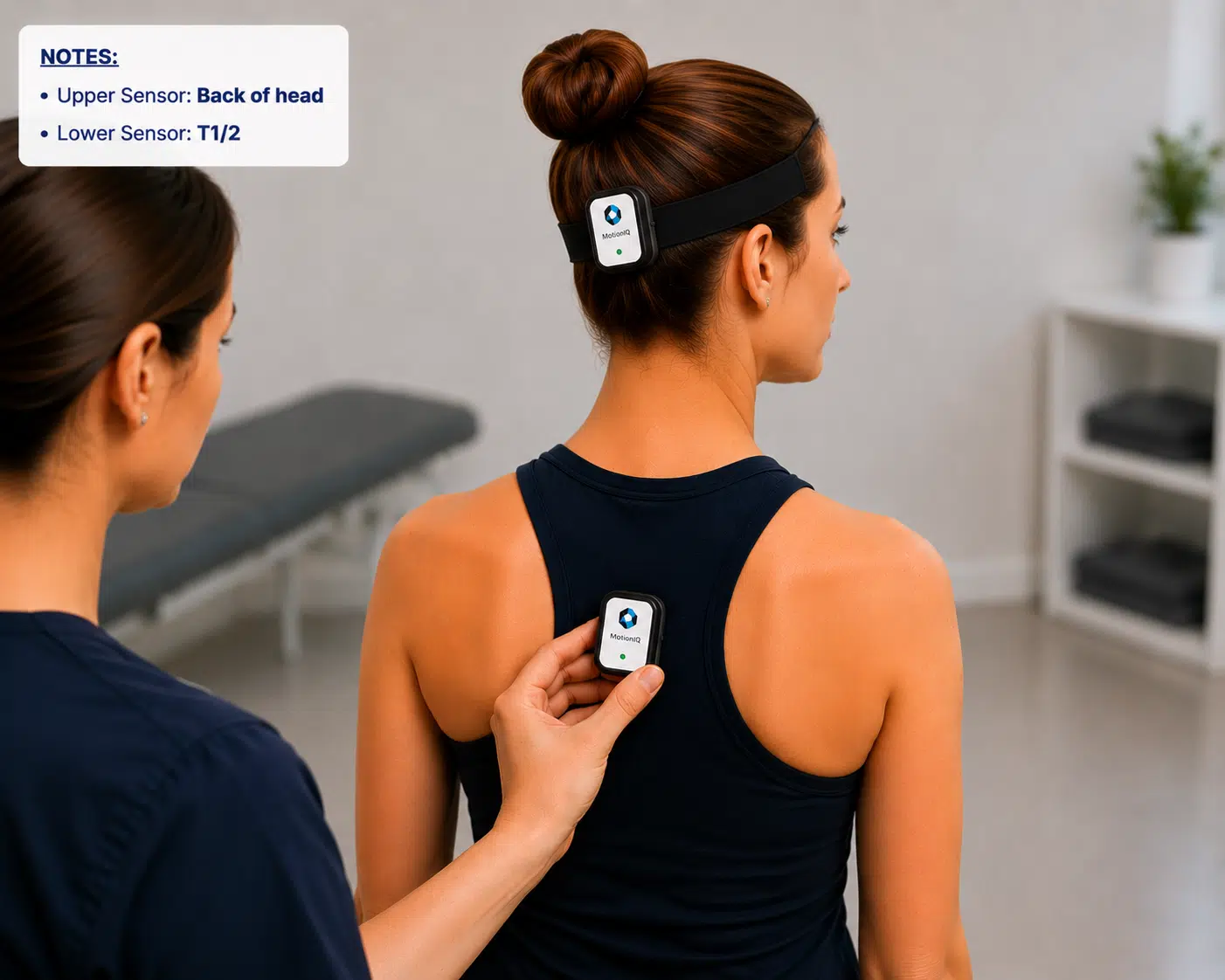
MotionIQ is the tool we use to put numbers on it. Small wireless sensors are strapped over your spine, and as you move through a few simple ranges they record every degree at 60 frames per second, down to a tenth of a degree. The scan takes under a minute and fits inside a normal appointment.
Our chiropractors use it routinely, so if you are booked in with one it will normally be part of your assessment. Our physiotherapists do not use it as a matter of course, so if you are seeing a physio and you specifically want a MotionIQ assessment, ask for it when you book and we will make sure it is included.
What that gives us:
- A baseline: exactly how far each region moves, in each direction, at your first assessment.
- The specific segment and direction that is limited, rather than a general sense that your lower back is tight.
- Left-versus-right differences that the eye cannot pick up.
- Motion loss found before it has produced much in the way of symptoms.
For shoulders, hips and knees we use standard clinical range of motion and strength testing. The principle is the same wherever we apply it: measure it, treat it, measure it again.
Re-measuring is the part that matters most

The measurement at your first visit is only half of it. The more useful number is the second one.
Partway through your care we run the same scan again and set it against your baseline. That answers a question "how does it feel?" never can: is the movement genuinely coming back? If it is, we have evidence the plan is doing its job. If a segment has not shifted, we know to change approach rather than repeat the same thing for another six weeks.
It also gives you a figure you can put next to the one from your first appointment, instead of a vague sense that things are looser. Every scan is saved, so the comparison stays available for as long as you keep coming.
Objective numbers are useful outside the clinic too. They strengthen reports to your GP, and insurer or WorkCover documentation, where "the patient reports improvement" carries far less weight than a measured change in degrees.
How this shapes your care
Measurement is where our assessments start. It tells us which segments to work on and in which direction, and it stops us treating the area that hurts when the restriction is sitting somewhere else. It also tells us when to change tack. Restoring lost motion is what we are aiming at, for the reasons above.
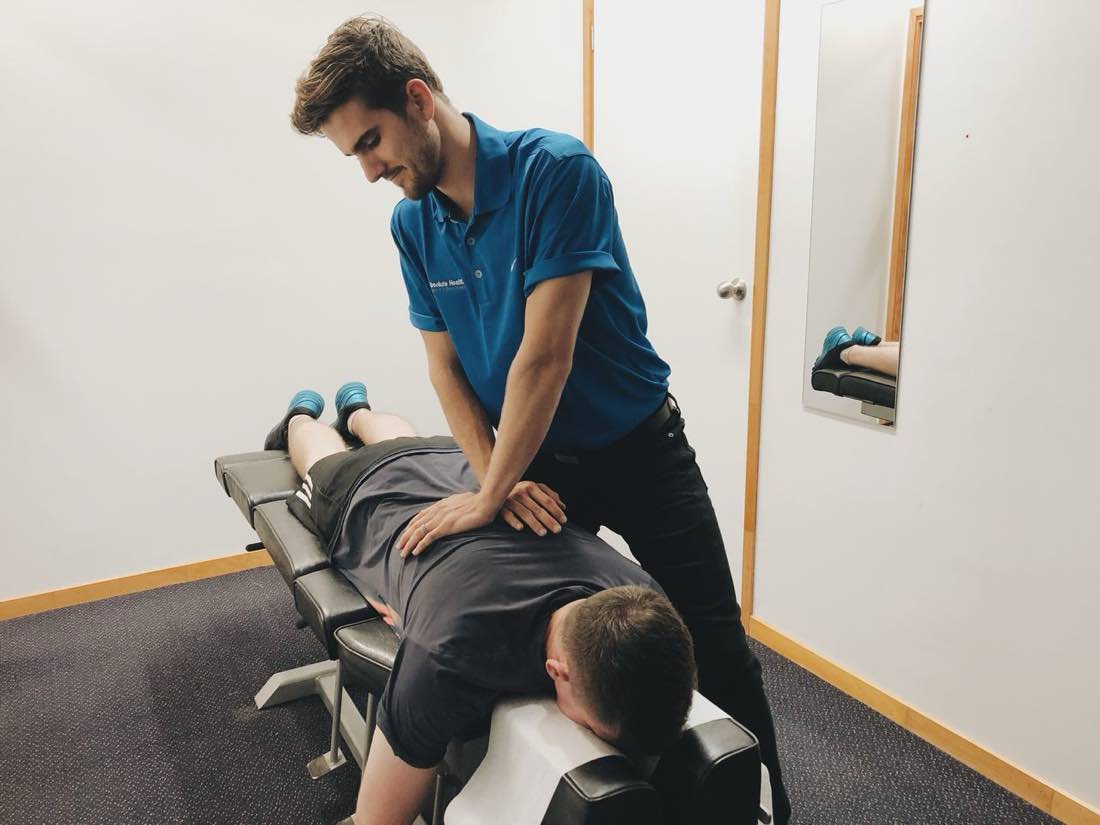
Measuring, treating and then measuring again is how our chiropractors work at both the Mooloolaba and Nambour clinics, and MotionIQ is a standard part of that. Our physiotherapists work to the same principle using clinical range of motion and strength testing, and can arrange a MotionIQ scan if you ask for one. You can see what a first appointment involves on our what to expect page. The conditions we most often assess this way include back pain, neck pain, sciatica, headaches, whiplash, disc herniations and scoliosis. Where a structural question needs answering as well, we have digital X-ray on site.
Want to know how your joints are actually moving?
Our chiropractors include a MotionIQ assessment as standard at Mooloolaba and Nambour, and same-day appointments are often available. Booking with a physiotherapist and want one included? Just ask when you book.
Common questions
Can a stiff joint really lead to arthritis?
A stiff joint is not a diagnosis of arthritis and most restricted joints never become arthritic. What the research supports is narrower: joints held out of normal motion for long periods develop osteoarthritis-like changes, and restoring motion partly reverses some of them. That is a good reason to treat lost range early rather than wait.
Is a MotionIQ scan uncomfortable?
No. Small wireless sensors are strapped to the skin over your spine and you move through a few ordinary ranges. There are no needles and no radiation, and the scan is done in under a minute.
How is this different from an X-ray?
An X-ray shows the structure of your spine while it is still. MotionIQ measures how it moves. The two answer different questions, and a joint can look reasonable on imaging while moving poorly. We use both when the situation calls for it.
How often do you re-measure?
It depends on your plan, but generally after a block of care rather than at every visit. The point is a fair comparison against your baseline, which needs enough time in between for a real change to show.
Can I have a MotionIQ assessment with a physiotherapist?
Yes, but it is not part of a standard physio appointment. All of our chiropractors use MotionIQ routinely. Our physiotherapists do not, so if you want a scan included with a physio appointment, please mention it when you book.
Do I need a referral?
No. You can book directly with either clinic. If you are seeing a chiropractor the assessment is included as a matter of course; with a physiotherapist, ask for it when you book.
References
- Gan D, Jin X, Wang X, et al. Pathological progress and remission strategies of osteoarthritic lesions caused by long-term joint immobilization. Arthritis Research & Therapy. 2023;25:237.
- Sun HB. Mechanical loading, cartilage degradation, and arthritis. Annals of the New York Academy of Sciences. 2010;1211:37–50.
- Leong DJ, Li YH, Gu XI, et al. Physiological loading of joints prevents cartilage degradation through CITED2. The FASEB Journal. 2011;25(1):182–191.
This article is general information and is not a substitute for individual assessment. If you have persistent pain or stiffness, have it looked at.